




"When will they ever learn?" is the refrain in a folk song that was popular in the 1960's. It would be a bit more accurate if it was when will WE ever learn?
This song was brought to mind by a conversation I had with a young woman in Barnes & Noble Tuesday. She had tons of stats at her command and was just as passionate as I was back in the day about conversevation. I tried to gently point out to her that we made a start then and if we'd kept on the path of alterternative sources of power we most likely wouldn't be having the problems we have today. I'm sure, of course, that we'd have some problems or the other that being the nature of existence. We didn't need to be repeating this particular set of problems caused by escalating oil prices. If we had continued developing our technologies for using solar, wind, geothermal, wave, water, and garbage conversion as energy sources we'd be far ahead of the game.
Instead, when oil prices stablized, people immediately went back to their old dependence on the substance and refused to pay the, then minor, extra price to develop and use alternative sources of power. We not only didn't move forward to develop these technologies we actively moved back in some cases. We need to keep in mind that while there is still a sufficient amount of oil available it isn't infinite. Solar and wind power may not be infinite either, but when we have problems with them energy will be the least of our worries.
Meanwhile there is the refrain, "What can I do?"
Here are some things I did back in the 1970's when one night I went to bed to gas at one price and woke up the next morning to discover it had doubled. Ah yes, gas has NEVER, EVER gone back to the price I saw that night on my way home from work.
Walk if at all possible.
Ride a bike.
Consoladate any trips you have to make in your car.
Plant a garden.
Use the mantra our grandmothers used in the 1930's:
"Use it up, make it do, do without."
Things you need to consider; if it isn't safe to walk in an area then don't. There really are places you should not be on foot. The same consideration applies to bikes.
If it is safe to walk, but you think you can't haul whatever you are going to get back in your hands then think about getting a basket on wheels, or use a small garden or child's wagon to carry the stuff.
Got a big dog?
Teach it to pull a cart to carry your supplies.
An additional benefit--the dog will not let someone take your cart while it is parked outside the store and the two of you will become even better friends as you work together.
If you live in an apartment you can't have a garden. Or can you? If you have friends who have a house with land see if they might be willing to let you use some of their yard for a small garden. If they already have a garden offer to help them work it.
Start a container garden. Tomatoes, peppers, chives and a lot of very expensive herbs can be grown in pots. This has the added advanage of cleaning the air in your living space.
Lazy Trainer's Tip
Free your mind by getting some of the old Foxfire books written back in the seventies and reading how others have faced the current problems and overcome them.
Oh yeah! I'll write up instructions on how to teach a dog to pull a cart and tell you where you can buy them.
Showing posts with label dog. Show all posts
Showing posts with label dog. Show all posts
Thursday, May 22, 2008

Thursday, May 15, 2008
Pep Talks
If yesterday’s blog seemed aimed at writers more than animal trainers that’s because it was. Specifically this writer. I need reminders that many projects are not going to be accomplished in one day or even one year. I need the occasional pep talk to keep me on track.
Currently I’m working on an equine version of Marley and Me with Doc as Marley. This is going to take awhile. I already have about a quarter of the first draft done. I tend to begin a book with a vague idea that I jot down on an index card. I add index cards as more ideas present themselves. I try to have only one idea/scene per index card. Usually a book takes about 100 index cards; give or take a few.
Once I have my cards I put them in some sort of order and create an outline on my computer. The outline is a little more detailed than the index cards and gives me a better idea of how the narrative is going to flow.
This is somewhat how I deal with training animals. I acquire the horse, dog or cat, i.e. idea. I then spend some time observing it and learning its personality. Usually I give a horse or dog a week to get used to its new environment. I keep it in a stall or pen so it won’t get into trouble and has a chance to see how things work between us and the other animals. New cats are also kept separate from the clowder, but it usually takes longer for them to settle in and be comfortable with the new life.
Once an animal has settled in I begin with a grooming session. As I’ve mentioned before this translates with horses to “I’m the leader.” I’m not sure exactly how this works with dogs, but I do know things go better once a dog accepts my right to groom him. As we go through grooming I find all the areas the animal isn’t comfortable being handled and begin to work on these. This may take minutes or months, but I keep going.
My usual pattern for training sessions with animals or people is to begin at the beginning and keep going forward until a problem shows up. That is where the day’s training/work session begins. Over the years I’ve discovered I have to do things slightly differently when I’m writing; especially when I am writing a book.
I cannot allow myself to review previous material too far back (in fact I try to set things up so I only see the last paragraph I wrote the day before) or else I’ll be rewriting before I’ve finished writing my first draft. Down this road lies confusion, aggravation and unfinished manuscripts, so I try very hard not to do it anymore.
First draft first; THEN rewrite. I make notes about potential changes as I go and use different color text so I know when I begin my rewrites that this is a particular area that needs work.
When training horses (or dogs for that matter) I had to learn to keep moving forward. Doing the same thing over and over hoping for perfection led to the opposite result. Finally a dressage instructor gave me an important key to the problem. She said, “Once you get fifty on something, move on. Staying there will only lead to boredom and frustration. Moving on to the next thing will result in improving the previous exercises.”
If you are wondering about the significance of a fifty—when taking a dressage test the score is determined on a scale of zero to ten. Tens are so rare anyone getting a ten frames the test and puts it where everyone can see it. Sixty and seventy is good enough to win gold.
Lazy Trainer’s Tip
When you and your horse have a good feel for the task, move on to the next one. Warm up and cool down will be sufficient to keep the previous lessons fresh and on the road to improvement.
Currently I’m working on an equine version of Marley and Me with Doc as Marley. This is going to take awhile. I already have about a quarter of the first draft done. I tend to begin a book with a vague idea that I jot down on an index card. I add index cards as more ideas present themselves. I try to have only one idea/scene per index card. Usually a book takes about 100 index cards; give or take a few.
Once I have my cards I put them in some sort of order and create an outline on my computer. The outline is a little more detailed than the index cards and gives me a better idea of how the narrative is going to flow.
This is somewhat how I deal with training animals. I acquire the horse, dog or cat, i.e. idea. I then spend some time observing it and learning its personality. Usually I give a horse or dog a week to get used to its new environment. I keep it in a stall or pen so it won’t get into trouble and has a chance to see how things work between us and the other animals. New cats are also kept separate from the clowder, but it usually takes longer for them to settle in and be comfortable with the new life.
Once an animal has settled in I begin with a grooming session. As I’ve mentioned before this translates with horses to “I’m the leader.” I’m not sure exactly how this works with dogs, but I do know things go better once a dog accepts my right to groom him. As we go through grooming I find all the areas the animal isn’t comfortable being handled and begin to work on these. This may take minutes or months, but I keep going.
My usual pattern for training sessions with animals or people is to begin at the beginning and keep going forward until a problem shows up. That is where the day’s training/work session begins. Over the years I’ve discovered I have to do things slightly differently when I’m writing; especially when I am writing a book.
I cannot allow myself to review previous material too far back (in fact I try to set things up so I only see the last paragraph I wrote the day before) or else I’ll be rewriting before I’ve finished writing my first draft. Down this road lies confusion, aggravation and unfinished manuscripts, so I try very hard not to do it anymore.
First draft first; THEN rewrite. I make notes about potential changes as I go and use different color text so I know when I begin my rewrites that this is a particular area that needs work.
When training horses (or dogs for that matter) I had to learn to keep moving forward. Doing the same thing over and over hoping for perfection led to the opposite result. Finally a dressage instructor gave me an important key to the problem. She said, “Once you get fifty on something, move on. Staying there will only lead to boredom and frustration. Moving on to the next thing will result in improving the previous exercises.”
If you are wondering about the significance of a fifty—when taking a dressage test the score is determined on a scale of zero to ten. Tens are so rare anyone getting a ten frames the test and puts it where everyone can see it. Sixty and seventy is good enough to win gold.
Lazy Trainer’s Tip
When you and your horse have a good feel for the task, move on to the next one. Warm up and cool down will be sufficient to keep the previous lessons fresh and on the road to improvement.
Friday, May 9, 2008
Just what IS lazy?
I thought about this question after watching a woman and her dog in one of the pet allowed stores get in a major battle over whether or not the dog was going to get to keep a bag of dog bones it grabbed. It was a pretty good sized dog and it took several minutes for her to get the bag back. Just out of curiosity I kept following the pair and watching the show.
Now a lazy dog owner would have taken a different path to resolve the various issues. Some, the truly lazy, would never take their dog into such a store anyway. Another type of lazy would put the dog in a basket and push it around.
A smart lazy, the kind I am and advocate, would stop the problem before it got going. A quick correction when the dog first looked (a dog looks with its nose first incidentally) at the shelf of goodies would have kept the whole ruckus from happening.
Something I had to teach my students over and over again is that you can’t just sit on a horse hoping it will behave. You have to take an active part in the process and the quicker you get active the less work you’ll have to do and that is being smart lazy.
This is a pretty good plan to follow with children, employees, dogs, horses or any other being you are in charge of. See the problem and take steps early on to redirect. Don’t just wait and watch, hoping the wreck won’t happen.
Incidentally the wait, watch, hope strategy is really unfair to all concerned. When you do this it takes a LOT more effort to correct any problems and can leave the one corrected feeling confused and abused; which then sets up a whole new round of problems.
Lazy Trainer’s Tip
When you see the very first hint of a problem take action right THEN and THERE. An huh-huh, a tiny sideways tug on the leash, a stop of the hands on the reins or the seat in the saddle, can keep a tiny problem from becoming a major one and will not cause the resentment a bigger correction can.
Now a lazy dog owner would have taken a different path to resolve the various issues. Some, the truly lazy, would never take their dog into such a store anyway. Another type of lazy would put the dog in a basket and push it around.
A smart lazy, the kind I am and advocate, would stop the problem before it got going. A quick correction when the dog first looked (a dog looks with its nose first incidentally) at the shelf of goodies would have kept the whole ruckus from happening.
Something I had to teach my students over and over again is that you can’t just sit on a horse hoping it will behave. You have to take an active part in the process and the quicker you get active the less work you’ll have to do and that is being smart lazy.
This is a pretty good plan to follow with children, employees, dogs, horses or any other being you are in charge of. See the problem and take steps early on to redirect. Don’t just wait and watch, hoping the wreck won’t happen.
Incidentally the wait, watch, hope strategy is really unfair to all concerned. When you do this it takes a LOT more effort to correct any problems and can leave the one corrected feeling confused and abused; which then sets up a whole new round of problems.
Lazy Trainer’s Tip
When you see the very first hint of a problem take action right THEN and THERE. An huh-huh, a tiny sideways tug on the leash, a stop of the hands on the reins or the seat in the saddle, can keep a tiny problem from becoming a major one and will not cause the resentment a bigger correction can.
Tuesday, May 6, 2008
Voices
I love to watch Dirty Jobs. Mike Rowe has a wonderful voice, thanks to his training as an opera singer. I also have to admit that when watching him deal with horses I frequently end up laughing myself silly.
Last night I was watching him handle a group of draft horses and was amused at both his body language and his voice. While trying to lead four Belgium horses (he called them Percherons, but if you want to know what a Percheron really looks like look at Doc's picture) he tried to slow them down and stop them by repeating whoa in an increasingly higher tone of voice. The body language alone was enough to cause the horses to ignore him, but add the voice and you were assured those horses were not going to regard him as anyone to take seriously.
When I was a teen I thought I wanted to be a vet. It was the wrong time because women were not allowed in vet school; which was a good thing in my case. While I’m very good at dealing with animals I’m lousy when it comes to dealing with humans. A vet has to be good with humans as well as animals.
Nevertheless, I got a job in a vet clinic while I was in high school and learned a lot there. One thing I learned was the importance of quiet confidence when it comes to handling any animal, regardless of species.
An early example of this was the day a woman brought her Peke in for his annual check up and shots. When the little guy strutted into the examination room I said "Hi, kiddo," and reached down, grabbed him firmly and hoisted him onto the table. Everyone, the Doctor included, gasped. It seems this particular dog had quite a reputation for biting.
I’ll have to confess here that I had an advantage concerning this particular dog. He was one of my mother’s breeding. I knew how he’d been started out and his basic temperament so I had confidence that he was a sensible dog. Which he was, he’d just been allowed to think he was top dog in his household and took full advantage of it. When confronted with a person who knew better he was perfectly willing to behave.
That absolute confidence is what every animal trainer needs in order to handle animals safely. Without it even a Chihuahua can control the human. With it a human can control an elephant. The confidence has to come from knowledge and skill. But we humans like to use our voices. We are a very vocal species. We can use this tendency either in a right way or wrong way.
It is necessary to learn how to “read” an animal and its body language. Dogs are fairly easy because they are predators and humans are predators. We have a common language that we can use. Horses are difficult because they are strictly prey animals and have a vested interest in doing just the opposite of what we want them to do.
One of the first things I always tell students is “Everything you want to do naturally is wrong.”
In working with horses we have to completely retrain ourselves in order to gain a horse’s trust and cooperation. This takes years of effort and practice. Gaining that absolute confidence is a long journey and there are more than a few pit falls along the way.
None of this is to say you can handle dogs without making the effort to acquire knowledge and practice skills; because you must learn how to meet their needs and communicate in a manner the dog can understand in order to have a successful partnership with your canine companion.
One huge mistake a lot (really most) people make with both dogs and horses is using a high pitched voice. The reason this is so wrong is because among horses high pitches signal danger and distress. Dogs have a different take on a high pitched voice. To them this is the sign of a prey animal they can take down. As you can see the reactions of horses and dogs are opposite, but the result is bad for humans in both cases.
Low pitches to horses are friendly. These are the pitches used among companions, mares and their foals, a stallion to a mare. Low pitch is good.
Likewise low, calm pitched voices are good with dogs because this doesn’t rev their hunting and killing drives.
In addition to low-slow speech is also a good thing. Animals have lightening quick reflexes and the more you can slow these down the easier it is to handle your horse or dog.
Lazy Trainer’s Tip
About the most important thing you can do when around animals (besides using correct body language) is always use a low pitch when speaking. Practice using the lowest pitch you are capable of until it becomes second nature when you are in the presence of a horse or dog.
Don’t forget to add slow to this practice as well. While body language is how both dogs and horses really do most of their communicating they do use some vocalization and we can take advantage of this by keeping the low and slow mantra in mind.
Last night I was watching him handle a group of draft horses and was amused at both his body language and his voice. While trying to lead four Belgium horses (he called them Percherons, but if you want to know what a Percheron really looks like look at Doc's picture) he tried to slow them down and stop them by repeating whoa in an increasingly higher tone of voice. The body language alone was enough to cause the horses to ignore him, but add the voice and you were assured those horses were not going to regard him as anyone to take seriously.
When I was a teen I thought I wanted to be a vet. It was the wrong time because women were not allowed in vet school; which was a good thing in my case. While I’m very good at dealing with animals I’m lousy when it comes to dealing with humans. A vet has to be good with humans as well as animals.
Nevertheless, I got a job in a vet clinic while I was in high school and learned a lot there. One thing I learned was the importance of quiet confidence when it comes to handling any animal, regardless of species.
An early example of this was the day a woman brought her Peke in for his annual check up and shots. When the little guy strutted into the examination room I said "Hi, kiddo," and reached down, grabbed him firmly and hoisted him onto the table. Everyone, the Doctor included, gasped. It seems this particular dog had quite a reputation for biting.
I’ll have to confess here that I had an advantage concerning this particular dog. He was one of my mother’s breeding. I knew how he’d been started out and his basic temperament so I had confidence that he was a sensible dog. Which he was, he’d just been allowed to think he was top dog in his household and took full advantage of it. When confronted with a person who knew better he was perfectly willing to behave.
That absolute confidence is what every animal trainer needs in order to handle animals safely. Without it even a Chihuahua can control the human. With it a human can control an elephant. The confidence has to come from knowledge and skill. But we humans like to use our voices. We are a very vocal species. We can use this tendency either in a right way or wrong way.
It is necessary to learn how to “read” an animal and its body language. Dogs are fairly easy because they are predators and humans are predators. We have a common language that we can use. Horses are difficult because they are strictly prey animals and have a vested interest in doing just the opposite of what we want them to do.
One of the first things I always tell students is “Everything you want to do naturally is wrong.”
In working with horses we have to completely retrain ourselves in order to gain a horse’s trust and cooperation. This takes years of effort and practice. Gaining that absolute confidence is a long journey and there are more than a few pit falls along the way.
None of this is to say you can handle dogs without making the effort to acquire knowledge and practice skills; because you must learn how to meet their needs and communicate in a manner the dog can understand in order to have a successful partnership with your canine companion.
One huge mistake a lot (really most) people make with both dogs and horses is using a high pitched voice. The reason this is so wrong is because among horses high pitches signal danger and distress. Dogs have a different take on a high pitched voice. To them this is the sign of a prey animal they can take down. As you can see the reactions of horses and dogs are opposite, but the result is bad for humans in both cases.
Low pitches to horses are friendly. These are the pitches used among companions, mares and their foals, a stallion to a mare. Low pitch is good.
Likewise low, calm pitched voices are good with dogs because this doesn’t rev their hunting and killing drives.
In addition to low-slow speech is also a good thing. Animals have lightening quick reflexes and the more you can slow these down the easier it is to handle your horse or dog.
Lazy Trainer’s Tip
About the most important thing you can do when around animals (besides using correct body language) is always use a low pitch when speaking. Practice using the lowest pitch you are capable of until it becomes second nature when you are in the presence of a horse or dog.
Don’t forget to add slow to this practice as well. While body language is how both dogs and horses really do most of their communicating they do use some vocalization and we can take advantage of this by keeping the low and slow mantra in mind.
Sunday, May 4, 2008
Some Definitions of Leader
The Encarta Dictionary offers some of the following definitions of what a leader is;
1. Someone people follow
2. Someone in the lead
3. Someone in charge
I’ll add the definition most of us pick up in our first years in school
4. First in line
Notice that the idea a leader should be trustworthy is not included. Yet that is the very foundation of being a leader of a herd of horses or pack of dogs. It is also critical to cows and goats. I do not include other animals because I have not had a chance to observe group interactions as I have with these animals.
A common mistake a lot of people make is that control and leading are the same things. They are not. Most of us want control of our immediate environment, but we don’t want to be the one responsible for everybody else. This is okay. Too many leaders can lead to chaos as anyone who has dealt with two alphas (i.e. leader types) in a group of animals can attest. Something many don’t realize is that among horses two omegas can cause just as much chaos. I’ll do a blog on that later.
I was raised as an only child among older adults. I saw my cousins a couple of times a year and occasionally played with a little girl that lived several blocks away from me. I had no skills in dealing with groups of other children when I went to school.
We started in first grade back in those days. I was a leading baby boomer so the class was large—about thirty children. Further more I was the only one who spoke English for the first couple of months. Everyone else in class spoke Spanish. They also had lovely, straight, black hair, large brown eyes and beautiful tanned skin that didn’t burn to a bright red when they stayed out in the sun for fifteen minutes. I had curly light brown hair, green eyes and the pale hide that burned.
I was raised by people who were accustomed to dealing with animals. The closest thing I had to a sibling was my mother’s stud dog, a Pekingese with the kennel name of Pug, and a cat of my grandmother’s. My grandmother had been a horse trainer in her youth (someone had to teach horses to wear sidesaddles and not spook at skirts) and kept a few chickens even in the heart of San Antonio, Texas, which is where I grew up. Animals I knew. My perception of people was they were big and wanted me to stay out of their way.
My first grade teacher decided I was going to be a “leader” because I already spoke English. I wanted to learn Spanish so I could talk to the other kids. Because of this we all got in trouble. The other kids decided I was not a good leader because they got a lecture on the main rule, which at the time was, “Spanish is not allowed at any time during school.”
What they didn’t know was I got taken to the principal’s office and my grandmother (my primary caregiver) called in to deal with my disobedience. Because I spoke English I was some how supposed to know better than to break the RULE!
The next thing that happened was later in the year when I won a spelling contest. By then there were several other children in the class who were not Mexican American. One was Chinese American and the other three were like me, northern European and/or British mutts.
Just in case you haven’t figured it out I know very well what it is to be a minority. It wasn’t fun.
Back to the spelling bee. I won it and got a mechanical rabbit for my prize. When I got back to my table the girl who was my best friend declared, “I hate you. I wanted that rabbit and I’m never going to speak to you again.”
Forever was ten minutes, but I never won another contest. In fact, I decided third place was a good safe place to be. No one gets too upset if you place third. Any first place prizes I acquired after that were by sheer accident.
That was also when I decided being a leader meant having a big bull’s
eye painted on your back.
It was twenty years before I connected that what I was doing with animals was leadership and that I could use the same techniques with humans.
Being the leader does not just mean being first. It can mean being the one who knows which direction to take. Call it being the navigator if leader is an uncomfortable title. The leader/navigator of a herd or pack is the one that knows where food, water and safety is. They know where they are supposed to go and what to do when they get there. The one that knows these things will be the real leader even if they are in the middle of the herd.
When watching a herd of horse the way to determine the lead mare is not by who is first in from pasture, but which horse all the others turn to when something out-of-the-ordinary happens. That is the true leader of the herd. The true lead male (who can be a gelding) is the one that gets between the herd and danger.
So, being the leader to you horse or dog means; knowing how to meet the needs of your animal, keeping it out of trouble and protecting it when danger threatens. It isn’t about being the one who yells the loudest or beats up on others. It is about knowledge and protection. It is also an excellent way to take care of your family.
Once I realized those points I sometimes did allow myself to be the leader of a group of humans as well as an animal leader. Sometimes a group needs someone to pick a direction and when someone does that person tends to end up leading the group.
There are a lot of bad leaders in our world. They are all about being first and doing things for themselves. We don’t need that kind of leader any more than a herd of horses or a pack of dogs does. We need superior navigators who will guide the group and protect it.
This is what we need to be to our animals. We take them into our lives and unnatural circumstances therefore it is up to us to teach them the rules and guide them to the safe places in our world.
1. Someone people follow
2. Someone in the lead
3. Someone in charge
I’ll add the definition most of us pick up in our first years in school
4. First in line
Notice that the idea a leader should be trustworthy is not included. Yet that is the very foundation of being a leader of a herd of horses or pack of dogs. It is also critical to cows and goats. I do not include other animals because I have not had a chance to observe group interactions as I have with these animals.
A common mistake a lot of people make is that control and leading are the same things. They are not. Most of us want control of our immediate environment, but we don’t want to be the one responsible for everybody else. This is okay. Too many leaders can lead to chaos as anyone who has dealt with two alphas (i.e. leader types) in a group of animals can attest. Something many don’t realize is that among horses two omegas can cause just as much chaos. I’ll do a blog on that later.
I was raised as an only child among older adults. I saw my cousins a couple of times a year and occasionally played with a little girl that lived several blocks away from me. I had no skills in dealing with groups of other children when I went to school.
We started in first grade back in those days. I was a leading baby boomer so the class was large—about thirty children. Further more I was the only one who spoke English for the first couple of months. Everyone else in class spoke Spanish. They also had lovely, straight, black hair, large brown eyes and beautiful tanned skin that didn’t burn to a bright red when they stayed out in the sun for fifteen minutes. I had curly light brown hair, green eyes and the pale hide that burned.
I was raised by people who were accustomed to dealing with animals. The closest thing I had to a sibling was my mother’s stud dog, a Pekingese with the kennel name of Pug, and a cat of my grandmother’s. My grandmother had been a horse trainer in her youth (someone had to teach horses to wear sidesaddles and not spook at skirts) and kept a few chickens even in the heart of San Antonio, Texas, which is where I grew up. Animals I knew. My perception of people was they were big and wanted me to stay out of their way.
My first grade teacher decided I was going to be a “leader” because I already spoke English. I wanted to learn Spanish so I could talk to the other kids. Because of this we all got in trouble. The other kids decided I was not a good leader because they got a lecture on the main rule, which at the time was, “Spanish is not allowed at any time during school.”
What they didn’t know was I got taken to the principal’s office and my grandmother (my primary caregiver) called in to deal with my disobedience. Because I spoke English I was some how supposed to know better than to break the RULE!
The next thing that happened was later in the year when I won a spelling contest. By then there were several other children in the class who were not Mexican American. One was Chinese American and the other three were like me, northern European and/or British mutts.
Just in case you haven’t figured it out I know very well what it is to be a minority. It wasn’t fun.
Back to the spelling bee. I won it and got a mechanical rabbit for my prize. When I got back to my table the girl who was my best friend declared, “I hate you. I wanted that rabbit and I’m never going to speak to you again.”
Forever was ten minutes, but I never won another contest. In fact, I decided third place was a good safe place to be. No one gets too upset if you place third. Any first place prizes I acquired after that were by sheer accident.
That was also when I decided being a leader meant having a big bull’s
eye painted on your back.
It was twenty years before I connected that what I was doing with animals was leadership and that I could use the same techniques with humans.
Being the leader does not just mean being first. It can mean being the one who knows which direction to take. Call it being the navigator if leader is an uncomfortable title. The leader/navigator of a herd or pack is the one that knows where food, water and safety is. They know where they are supposed to go and what to do when they get there. The one that knows these things will be the real leader even if they are in the middle of the herd.
When watching a herd of horse the way to determine the lead mare is not by who is first in from pasture, but which horse all the others turn to when something out-of-the-ordinary happens. That is the true leader of the herd. The true lead male (who can be a gelding) is the one that gets between the herd and danger.
So, being the leader to you horse or dog means; knowing how to meet the needs of your animal, keeping it out of trouble and protecting it when danger threatens. It isn’t about being the one who yells the loudest or beats up on others. It is about knowledge and protection. It is also an excellent way to take care of your family.
Once I realized those points I sometimes did allow myself to be the leader of a group of humans as well as an animal leader. Sometimes a group needs someone to pick a direction and when someone does that person tends to end up leading the group.
There are a lot of bad leaders in our world. They are all about being first and doing things for themselves. We don’t need that kind of leader any more than a herd of horses or a pack of dogs does. We need superior navigators who will guide the group and protect it.
This is what we need to be to our animals. We take them into our lives and unnatural circumstances therefore it is up to us to teach them the rules and guide them to the safe places in our world.
Friday, May 2, 2008
Leadership is everything to a Lazy Trainer
“A little learning is a dangerous thing.” Ignorance is too, so one might as well make it a point to learn.
When trying to teach others how to train their animals the most difficult thing to teach is just how much effort is really needed to accomplish a goal. The correct answer is just as much as it takes and no more.
Too much effort is just as bad as too little effort when teaching an animal something. This is also true when we are training people.
Just how far is it necessary to go in order to train a horse or dog? The following story will demonstrate the far end of the “As much as it takes” scale.
I had been training horses and people for twenty-five years, but had gaps where my methods fell far short of my goals. I was an accomplished trainer and many would say the places I failed were just because the animals weren’t suited for the task. Deep in my heart I knew the real fault lay within me not the horse or dog. But I didn’t know how to correct the problems.
A friend gave me a ticket to a Parelli clinic and it was as if a whole new universe had opened up to me. Through the application of the Seven Games I began to mend the holes in my methods. For a year or so everything went great. I was frustrated in the beginning because I was using too much effort to get my horses to do what I wanted but I began to see how to damp down my body language so it became easier and easier to do whatever it was I wanted to do.
I began to think I’d really gotten the hang of things when a friend mentioned some problems she was having with her mare. The mare is one that we had trained together and she was endlessly patient with my friend’s grandchildren, but she only had one speed sloooow. Since she was an Arabian this was quite puzzlement to anyone who dealt with her.
I went to my friend’s stable and we started using the Seven Games with the mare. Things were going along pretty well. I forgot one important thing a trainer had told me many, many years before; “The most dangerous horse you’ll ever tackle is the old packer horse that is convinced it is in charge. That horse will not give up its alpha position without a fight.”
Six weeks into the Arabian mare’s rehab I found out just how dangerous that reliable packer horse could be.
The session started out well enough. We played the Friendly Game, the Porcupine Game, the Driving Game, the Yo-yo Game (though she drug furrows in the dirt when I asked her to back up) and were on to the Circle Game. There is where it all went to heck-in-a-handbasket. I halted her, and before sending her in the opposite direction, asked her to back up. It was both the biggest mistake I ever made and the smartest thing I ever did.
At that first Parelli clinic the instructor spent the first session teaching the people, without their horses, how to use their equipment. One of the exercises was rope twirling. Now this sounds silly. What does twirling the end of a lead rope have to do with training a horse? Turns out—a LOT. I took her seriously and practiced the twirling until I could do it with both right and left hand. I could also touch any target I aimed at with the little leather bit on the end of the lead rope. A far more valuable skill than I realized at the time.
When I asked my friend’s mare to back she decided she’d had enough of this human challenging her authority. Now, unlike a dog, a horse is not out to kill. Even the worst horse is actually acting from fear or the need to maintain herd position. The only problem is a horse can dish out and take a lot of punishment. A kick that will make another horse back off a step or two can kill a human. A bite that will merely correct a disobedient herd member can remove a human arm. So, though the intent isn’t to kill it can still be deadly.
The mare slicked back her ears and came straight down the rope, mouth agape, headed for me. I don’t mind saying that was one of the most frightening sights I’ve ever seen in my career. I twirled the rope and caught her on the end of the nose with that little leather bit. It stopped her first charge. It did not stop her attempt to subdue me. We spent the next twenty minutes with her making every attempt to put me in my place as a beta to her alpha.
Finally, both of us dripping with sweat, she stood and dropped her head. I asked her to back and she did. Then she made a ‘lick and chew’ motion with her lips. This is a sure sign a horse has accepted new knowledge; which in this case was that I was her leader.
I walked up to her and rubbed her neck, not realizing at that time that I was reaffirming my alpha status. Grooming is very important because only a higher ranked horse can initiate a grooming session.
In most cases establishing myself as leader requires no more than walking up to a horse with a confident manner (and make no mistake, after that session with the Arabian mare, my confidence is real) moving it out of its place, occupying territory and then rubbing its neck.
But the most important thing, the reason people like Pat Parelli and Cesar Millan are so successful with animals, is that once in the presence of an animal it is necessary to do whatever it takes to gain the leadership position. This is not accomplished by being cruel. It is done by doing only what needs to be done. Like Doc in the previous post it may only be necessary to crowd the horse or dog until they move and yield space. Or it may be necessary to stay in the fight until the animal yields.
If you are going to deal with difficult animals you MUST accept that you will get bitten, kicked, pawed, clawed and body slammed. But you have to hang in there until you’ve convinced the animal to accept you as the leader.
Most animals and most people are looking for a leader they can trust. If you are that leader your cat, dog, horse or other humans will follow you and do your bidding willingly. The reason there is sometimes a fight is because the subject, be it animal or human, has learned that others are not trustworthy.
Lazy Trainer Tips
Confidence is everything. When you buy or otherwise acquire a horse or dog choose one that you are confident you can handle. If you are a couch potato don’t go out and buy a young Arabian or Thoroughbred. In fact, don’t buy a young horse of any kind. If it is a dog you are acquiring, again think about getting an older animal. A dog that is three or older is a wonderful animal to have. Depending on breed you can have it for a long time. I currently have a twenty-one year old rat terrier. She’s getting a bit creaky, but she is still pretty spry.
Practice with your equipment, leash, lead rope, whatever, before you try to use it with an animal. Like the ‘rope-twirling’ the ability to react without conscious effort may even be life-saving for you or your animal.
Before getting any animal learn what that animal needs in a leader. And then commit yourself to being that leader. You owe it to any animal you bring into your world to do the best you can by it. That means being a good, trustworthy leader as well as meeting its needs for food, shelter and other necessities.
Your reward for practicing good leadership skills with your horse, cat or dog will be an unconditional love and friendship. This is something a lot of us need in our busy, stress filled lives.
When trying to teach others how to train their animals the most difficult thing to teach is just how much effort is really needed to accomplish a goal. The correct answer is just as much as it takes and no more.
Too much effort is just as bad as too little effort when teaching an animal something. This is also true when we are training people.
Just how far is it necessary to go in order to train a horse or dog? The following story will demonstrate the far end of the “As much as it takes” scale.
I had been training horses and people for twenty-five years, but had gaps where my methods fell far short of my goals. I was an accomplished trainer and many would say the places I failed were just because the animals weren’t suited for the task. Deep in my heart I knew the real fault lay within me not the horse or dog. But I didn’t know how to correct the problems.
A friend gave me a ticket to a Parelli clinic and it was as if a whole new universe had opened up to me. Through the application of the Seven Games I began to mend the holes in my methods. For a year or so everything went great. I was frustrated in the beginning because I was using too much effort to get my horses to do what I wanted but I began to see how to damp down my body language so it became easier and easier to do whatever it was I wanted to do.
I began to think I’d really gotten the hang of things when a friend mentioned some problems she was having with her mare. The mare is one that we had trained together and she was endlessly patient with my friend’s grandchildren, but she only had one speed sloooow. Since she was an Arabian this was quite puzzlement to anyone who dealt with her.
I went to my friend’s stable and we started using the Seven Games with the mare. Things were going along pretty well. I forgot one important thing a trainer had told me many, many years before; “The most dangerous horse you’ll ever tackle is the old packer horse that is convinced it is in charge. That horse will not give up its alpha position without a fight.”
Six weeks into the Arabian mare’s rehab I found out just how dangerous that reliable packer horse could be.
The session started out well enough. We played the Friendly Game, the Porcupine Game, the Driving Game, the Yo-yo Game (though she drug furrows in the dirt when I asked her to back up) and were on to the Circle Game. There is where it all went to heck-in-a-handbasket. I halted her, and before sending her in the opposite direction, asked her to back up. It was both the biggest mistake I ever made and the smartest thing I ever did.
At that first Parelli clinic the instructor spent the first session teaching the people, without their horses, how to use their equipment. One of the exercises was rope twirling. Now this sounds silly. What does twirling the end of a lead rope have to do with training a horse? Turns out—a LOT. I took her seriously and practiced the twirling until I could do it with both right and left hand. I could also touch any target I aimed at with the little leather bit on the end of the lead rope. A far more valuable skill than I realized at the time.
When I asked my friend’s mare to back she decided she’d had enough of this human challenging her authority. Now, unlike a dog, a horse is not out to kill. Even the worst horse is actually acting from fear or the need to maintain herd position. The only problem is a horse can dish out and take a lot of punishment. A kick that will make another horse back off a step or two can kill a human. A bite that will merely correct a disobedient herd member can remove a human arm. So, though the intent isn’t to kill it can still be deadly.
The mare slicked back her ears and came straight down the rope, mouth agape, headed for me. I don’t mind saying that was one of the most frightening sights I’ve ever seen in my career. I twirled the rope and caught her on the end of the nose with that little leather bit. It stopped her first charge. It did not stop her attempt to subdue me. We spent the next twenty minutes with her making every attempt to put me in my place as a beta to her alpha.
Finally, both of us dripping with sweat, she stood and dropped her head. I asked her to back and she did. Then she made a ‘lick and chew’ motion with her lips. This is a sure sign a horse has accepted new knowledge; which in this case was that I was her leader.
I walked up to her and rubbed her neck, not realizing at that time that I was reaffirming my alpha status. Grooming is very important because only a higher ranked horse can initiate a grooming session.
In most cases establishing myself as leader requires no more than walking up to a horse with a confident manner (and make no mistake, after that session with the Arabian mare, my confidence is real) moving it out of its place, occupying territory and then rubbing its neck.
But the most important thing, the reason people like Pat Parelli and Cesar Millan are so successful with animals, is that once in the presence of an animal it is necessary to do whatever it takes to gain the leadership position. This is not accomplished by being cruel. It is done by doing only what needs to be done. Like Doc in the previous post it may only be necessary to crowd the horse or dog until they move and yield space. Or it may be necessary to stay in the fight until the animal yields.
If you are going to deal with difficult animals you MUST accept that you will get bitten, kicked, pawed, clawed and body slammed. But you have to hang in there until you’ve convinced the animal to accept you as the leader.
Most animals and most people are looking for a leader they can trust. If you are that leader your cat, dog, horse or other humans will follow you and do your bidding willingly. The reason there is sometimes a fight is because the subject, be it animal or human, has learned that others are not trustworthy.
Lazy Trainer Tips
Confidence is everything. When you buy or otherwise acquire a horse or dog choose one that you are confident you can handle. If you are a couch potato don’t go out and buy a young Arabian or Thoroughbred. In fact, don’t buy a young horse of any kind. If it is a dog you are acquiring, again think about getting an older animal. A dog that is three or older is a wonderful animal to have. Depending on breed you can have it for a long time. I currently have a twenty-one year old rat terrier. She’s getting a bit creaky, but she is still pretty spry.
Practice with your equipment, leash, lead rope, whatever, before you try to use it with an animal. Like the ‘rope-twirling’ the ability to react without conscious effort may even be life-saving for you or your animal.
Before getting any animal learn what that animal needs in a leader. And then commit yourself to being that leader. You owe it to any animal you bring into your world to do the best you can by it. That means being a good, trustworthy leader as well as meeting its needs for food, shelter and other necessities.
Your reward for practicing good leadership skills with your horse, cat or dog will be an unconditional love and friendship. This is something a lot of us need in our busy, stress filled lives.
Thursday, May 1, 2008
Horse Trains Man
We had a family/friends get together and naturally wound up out with the horses. It is usually that way at our place.
Most of the people at our summer BBQ were experienced animal people and some were experienced with horses. We saddled my daughter’s horse, a twentysome-year-old Thoroughbred mare, and let anyone who wanted to ride. Foxy was a great horse. I didn’t get her until she was eighteen, but for the next ten years she took care of my daughter and students while teaching them good horse etiquette.
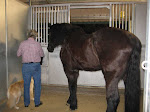
While she was giving rides Doc, my black stallion (now a long time gelding) was hanging with the people. He likes people, but he is also an alpha horse and any human, horse or other animal that comes within his reach is going to be tested. Most of the people instinctively (read—were well trained) knew to not give him an inch of ground. One man, the new husband of a horsewoman, didn’t know anything about horses.
Doc homed in on the man and when he got too close the man would move. It didn’t take long for the rest of us to notice what was going on. We all watched in unholy amusement as Doc herded the guy all around the group. When the man noticed us smiling, snickering and some (the kids of course) laughing outright he demanded to know what was so funny.
I finally explained to him that one way a dominant horse will exercise its will on another horse is by making the other horse move. Then the higher ranked horse will stand where the lower ranked horse was standing. Doc was training him to be an obedient herd member. Since the man was a fairly successful business executive this information came as an unpleasant shock. He was used to being the alpha and the notion that a horse had dominated him so quickly and effortlessly was not easy to accept.
It is easy to see this type of horse behavior in action at any place there is a gathering of horses and people. If you watch you will see people standing, holding their horse, talking to another person and, when the horse moves too close, they will move and let the horse stand where they were standing. The horse is convinced it is the dominant one of the pair.
Tip For The Day
The Lazy Trainer’s secret here is this--anyone dealing with horses should train themselves to never move when a horse begins encroaching on their territory. It is important to train yourself to always respond to a horse that is trying to move in on you by making the horse move and standing in its territory. At first it takes time and alertness to teach yourself this, but by making the effort consciously, all the time, you will eventually reach a point where your automatic response to a horse trying to move into your space will be to move the horse over and stand where it was standing.
Incidentally, this technique of occupying territory and claiming it also works with dogs. It isn’t always possible to transfer training methods from horses to dogs or dogs to horses because one is a predator and the other is prey. This means sometimes they have opposite reactions to stimuli. In the case of occupying territory though, both horses and dogs are inclined to regard this as a test of who is dominant within the group.
How much effort should you expend doing this? As much as it takes. How much is this? Well in my next blog I’ll tell you how much energy it took to convince a mare that’d been alpha to humans for a decade to move her feet and let me stand in her spot.
Most of the people at our summer BBQ were experienced animal people and some were experienced with horses. We saddled my daughter’s horse, a twentysome-year-old Thoroughbred mare, and let anyone who wanted to ride. Foxy was a great horse. I didn’t get her until she was eighteen, but for the next ten years she took care of my daughter and students while teaching them good horse etiquette.
While she was giving rides Doc, my black stallion (now a long time gelding) was hanging with the people. He likes people, but he is also an alpha horse and any human, horse or other animal that comes within his reach is going to be tested. Most of the people instinctively (read—were well trained) knew to not give him an inch of ground. One man, the new husband of a horsewoman, didn’t know anything about horses.
Doc homed in on the man and when he got too close the man would move. It didn’t take long for the rest of us to notice what was going on. We all watched in unholy amusement as Doc herded the guy all around the group. When the man noticed us smiling, snickering and some (the kids of course) laughing outright he demanded to know what was so funny.
I finally explained to him that one way a dominant horse will exercise its will on another horse is by making the other horse move. Then the higher ranked horse will stand where the lower ranked horse was standing. Doc was training him to be an obedient herd member. Since the man was a fairly successful business executive this information came as an unpleasant shock. He was used to being the alpha and the notion that a horse had dominated him so quickly and effortlessly was not easy to accept.
It is easy to see this type of horse behavior in action at any place there is a gathering of horses and people. If you watch you will see people standing, holding their horse, talking to another person and, when the horse moves too close, they will move and let the horse stand where they were standing. The horse is convinced it is the dominant one of the pair.
Tip For The Day
The Lazy Trainer’s secret here is this--anyone dealing with horses should train themselves to never move when a horse begins encroaching on their territory. It is important to train yourself to always respond to a horse that is trying to move in on you by making the horse move and standing in its territory. At first it takes time and alertness to teach yourself this, but by making the effort consciously, all the time, you will eventually reach a point where your automatic response to a horse trying to move into your space will be to move the horse over and stand where it was standing.
Incidentally, this technique of occupying territory and claiming it also works with dogs. It isn’t always possible to transfer training methods from horses to dogs or dogs to horses because one is a predator and the other is prey. This means sometimes they have opposite reactions to stimuli. In the case of occupying territory though, both horses and dogs are inclined to regard this as a test of who is dominant within the group.
How much effort should you expend doing this? As much as it takes. How much is this? Well in my next blog I’ll tell you how much energy it took to convince a mare that’d been alpha to humans for a decade to move her feet and let me stand in her spot.
Tuesday, April 29, 2008
Whose Fault Is It?
I am a lazy person. I've been assured of this many times in the past by family and teachers, so of course it must be true.
"It's never the horse. It's always the rider."
I heard that quote over and over as a kid when I was learning to ride. It was the response I got every time I said, "This horse won't do what I tell her too."
I used it myself when I began teaching and students whined, "This horse won't do what I tell it to."
The fact is the horse was ALWAYS doing what it was told to. It wasn't until I was involved in higher level dressage when I whimpered, "I know it is me, not the horse, but it is so tempting to blame her." that a teacher pointed out, "It really doesn't matter whose fault it is. You are the one who wants to do this. The horse would rather be out in pasture, hanging out with her friends, so it is up to YOU to make this possible. If you don't want it enough to make it happen it isn't going to happen."
My epiphany at that moment was that, no matter what animal I'm dealing with, I, the human, am the one that has brought this animal into my world. It is up to me to make things right. When I introduce an animal into our civilized world it is my job to take care of the animal and keep it safe. It is up to me to make sure the animal doesn't get into trouble with other people and animals.
It is not possible to accomplish my job of taking care of a horse, dog, cat or any other animal if I focus on the idea that a problem is the animal's fault. The animal is being what it is and I'm the one responsible for bringing it into an unnatural enviroment. Therefore it is my responsibility, no matter what my dog or horse or cat is doing, to make certain things go well.
If I've rescued an animal I cannot look at previous owners, circumstances or anything in the past and spend time blaming. That will not solve the problem in the now. I need to get on with resolving the issues that are before me right now.
In fact, when I look at life in general, I realize that as long as I focus on the idea that my problems, no matter what they are, are someone else's fault I cannot make my life better. I cannot make an animal's life better. I cannot make another person's life better. I have to own my own life and problems before I can get down to fixing anything.
In order to accomplish anything I have to be clever about it. So my first line of attack concerning any problem is to own it. My dog is barking because...my horse won't canter because...my cat is clawing the sofa... because I haven't trained it differently.
There it is; the whole Secret to Being a Lazy Trainer. It is always up to me. No one else can or will do it for me. Therefore I have to train myself first.
"It's never the horse. It's always the rider."
I heard that quote over and over as a kid when I was learning to ride. It was the response I got every time I said, "This horse won't do what I tell her too."
I used it myself when I began teaching and students whined, "This horse won't do what I tell it to."
The fact is the horse was ALWAYS doing what it was told to. It wasn't until I was involved in higher level dressage when I whimpered, "I know it is me, not the horse, but it is so tempting to blame her." that a teacher pointed out, "It really doesn't matter whose fault it is. You are the one who wants to do this. The horse would rather be out in pasture, hanging out with her friends, so it is up to YOU to make this possible. If you don't want it enough to make it happen it isn't going to happen."
My epiphany at that moment was that, no matter what animal I'm dealing with, I, the human, am the one that has brought this animal into my world. It is up to me to make things right. When I introduce an animal into our civilized world it is my job to take care of the animal and keep it safe. It is up to me to make sure the animal doesn't get into trouble with other people and animals.
It is not possible to accomplish my job of taking care of a horse, dog, cat or any other animal if I focus on the idea that a problem is the animal's fault. The animal is being what it is and I'm the one responsible for bringing it into an unnatural enviroment. Therefore it is my responsibility, no matter what my dog or horse or cat is doing, to make certain things go well.
If I've rescued an animal I cannot look at previous owners, circumstances or anything in the past and spend time blaming. That will not solve the problem in the now. I need to get on with resolving the issues that are before me right now.
In fact, when I look at life in general, I realize that as long as I focus on the idea that my problems, no matter what they are, are someone else's fault I cannot make my life better. I cannot make an animal's life better. I cannot make another person's life better. I have to own my own life and problems before I can get down to fixing anything.
In order to accomplish anything I have to be clever about it. So my first line of attack concerning any problem is to own it. My dog is barking because...my horse won't canter because...my cat is clawing the sofa... because I haven't trained it differently.
There it is; the whole Secret to Being a Lazy Trainer. It is always up to me. No one else can or will do it for me. Therefore I have to train myself first.
Subscribe to:
Posts (Atom)
