


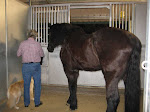
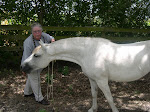


This weekend I got into a discussion about trainers and training methods with some other horse people. It got rather heated because I am a strong proponent of the Parelli method. I believe in it because it is designed to train people.
The old saying "Give a man a fish and you feed him for a day. Teach him to fish and you feed him for life." holds true when it comes to animal training. The following story is how I learned this important fact. Warning you may need something handy to blow your nose on during and after reading it.
First Client
I opened for business as a horse trainer in the late sixties. My first client was a big Appaloosa mare that was "stubborn" and wouldn't canter for her owner. Since I had been working for an Appaloosa breeder for the past three years I approached the project with confidence.
Within the month I had the mare walking, jogging, cantering, neck-reining, doing sliding stops etc. Her owner, who had been on vacation, came back and with some friends tried out his newly trained horse. Since I was working out of a public stable at the time the only control I had was over my horses and equipment.
He proceded to gallop the mare up and down the arena doing slidding stops until her mouth and legs were raw. His friends got on her and blooded her sides using spurs. When they were finished they said I was miracle worker becasue she'd never done that well before.
She stood there, sweating, sides heaving and bloody, and looked at me with eyes that said "I did what you wanted me to. Why are you letting them do this to me? Wasn't I a good girl? What have I done wrong?"
I never trained a horse FOR someone again. Either I trained both horse and rider or I didn't train.
The mare? I didn't have the money to buy her so she ended up at the killers.
Lazy Trainer Tip
Forget training animals, train the people is my motto and I'm one hundred percent behind Pat on this one.
Showing posts with label active training. Show all posts
Showing posts with label active training. Show all posts
Monday, June 30, 2008

Friday, May 9, 2008
Just what IS lazy?
I thought about this question after watching a woman and her dog in one of the pet allowed stores get in a major battle over whether or not the dog was going to get to keep a bag of dog bones it grabbed. It was a pretty good sized dog and it took several minutes for her to get the bag back. Just out of curiosity I kept following the pair and watching the show.
Now a lazy dog owner would have taken a different path to resolve the various issues. Some, the truly lazy, would never take their dog into such a store anyway. Another type of lazy would put the dog in a basket and push it around.
A smart lazy, the kind I am and advocate, would stop the problem before it got going. A quick correction when the dog first looked (a dog looks with its nose first incidentally) at the shelf of goodies would have kept the whole ruckus from happening.
Something I had to teach my students over and over again is that you can’t just sit on a horse hoping it will behave. You have to take an active part in the process and the quicker you get active the less work you’ll have to do and that is being smart lazy.
This is a pretty good plan to follow with children, employees, dogs, horses or any other being you are in charge of. See the problem and take steps early on to redirect. Don’t just wait and watch, hoping the wreck won’t happen.
Incidentally the wait, watch, hope strategy is really unfair to all concerned. When you do this it takes a LOT more effort to correct any problems and can leave the one corrected feeling confused and abused; which then sets up a whole new round of problems.
Lazy Trainer’s Tip
When you see the very first hint of a problem take action right THEN and THERE. An huh-huh, a tiny sideways tug on the leash, a stop of the hands on the reins or the seat in the saddle, can keep a tiny problem from becoming a major one and will not cause the resentment a bigger correction can.
Now a lazy dog owner would have taken a different path to resolve the various issues. Some, the truly lazy, would never take their dog into such a store anyway. Another type of lazy would put the dog in a basket and push it around.
A smart lazy, the kind I am and advocate, would stop the problem before it got going. A quick correction when the dog first looked (a dog looks with its nose first incidentally) at the shelf of goodies would have kept the whole ruckus from happening.
Something I had to teach my students over and over again is that you can’t just sit on a horse hoping it will behave. You have to take an active part in the process and the quicker you get active the less work you’ll have to do and that is being smart lazy.
This is a pretty good plan to follow with children, employees, dogs, horses or any other being you are in charge of. See the problem and take steps early on to redirect. Don’t just wait and watch, hoping the wreck won’t happen.
Incidentally the wait, watch, hope strategy is really unfair to all concerned. When you do this it takes a LOT more effort to correct any problems and can leave the one corrected feeling confused and abused; which then sets up a whole new round of problems.
Lazy Trainer’s Tip
When you see the very first hint of a problem take action right THEN and THERE. An huh-huh, a tiny sideways tug on the leash, a stop of the hands on the reins or the seat in the saddle, can keep a tiny problem from becoming a major one and will not cause the resentment a bigger correction can.
Subscribe to:
Posts (Atom)
