


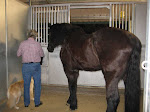
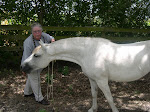


I received a tweet about a woman walking across America with her BLM horse. I will follow this journey with interest.
She calls her horse a Mustang, but just because a horse is feral doesn't mean it is a Mustang. Many of the BLM horses are mixtures of various breeds turned out or escaped over the years. In Nevada there are even some horses with Lipizzan blood in them because, many years ago, a Lipizzan stallion escaped and spent quite a while out there with the wild ones.
Back in the days when the US goverment bought huge numbers of horses Thoroughbred stallions were turned loose to "impove" the stock. Draft horses were turned loose during and after the deperession and added their blood to the mix.
Mustangs, as in desendents of the horses that came over with the Conquistedors, are not all that common.
http://www.walkingwithwinnie.com/why.html
Saturday, April 18, 2009

Wednesday, April 15, 2009
Home Again
Once we knew Chels was fine we started back. We stopped to see the grandchildren. Our daughter-in-law took us through the school showing us all the wonderful exhibts that were ready for the school's open house on Thursday.
The art work and science projects are absolutely amazing. There is such an amazing aray of talent among those children. I do have to brag that Brent and Brooke had some wonderful art work on display.
We went to lunch afterwards and then headed on home. Animals were well cared for thanks to our friend Betty.
Another friend, Mary Ann, helped us on the way by keeping us posted on the weather which was dicey.
Now, back to the normal, or almost normal. I've turned the horses into the yard and harvested the first spring greens from my garden. Onions, green beans and tomatoes are doing very well and I'm looking forward to their production soon.
The dogs are going nuts because Buddy likes to tease them by grazing just outside their fence. The cats are all stationed at various windows watching the many birds, who now have young just outside those windows.
Things seem to be back to normal. Or at least as normal as they ever get around here.
Tuesday, April 14, 2009
Heart Stopping
No matter how old or accomplished kids are they have the ability to stop a parent's heart with one phone call.
Our call came Easter Sunday evening; "I just vomited up a lot of blood, Mom. Please come."
While asking questions and making suggestions; "Don't try to drive yourself to the hospital. Get a friend too." and How long has this been going on?" "HOW LONG?" we rushed around throwing clothes into the suitcase and throwning food at the animals.
After getting off the phone with dear daughter, there were frantic calls to friends to please come take care of the animals. We set a personal record by being on the road in less than an hour from the first ring of that call.
All during the looooonnnnnngggggg six hour drive to Oklahoma City Chels' friends kept us posted as to what was happening. I even gave up my long standing resistence to texting and began using it.
We reached the hospital in the wee hours of the morning to find her in ICU. NOT because she was that badly off we were quickly reasured, but because they didn't have room for her anywhere else. When you consider this hospital spreads out over four good-sized city blocks you know that they must have had a heck of a weekend.
She is now out of hospital and doing well. Our friends rallied magnificently and we will soon be taking a much shorter six hour trip back home.
One of the great blessings of life are those friends who are willing to drop everything in their own busy lives to help when something goes awry in oru lives and I am truly greatful for the blessings of our friends.
Our call came Easter Sunday evening; "I just vomited up a lot of blood, Mom. Please come."
While asking questions and making suggestions; "Don't try to drive yourself to the hospital. Get a friend too." and How long has this been going on?" "HOW LONG?" we rushed around throwing clothes into the suitcase and throwning food at the animals.
After getting off the phone with dear daughter, there were frantic calls to friends to please come take care of the animals. We set a personal record by being on the road in less than an hour from the first ring of that call.
All during the looooonnnnnngggggg six hour drive to Oklahoma City Chels' friends kept us posted as to what was happening. I even gave up my long standing resistence to texting and began using it.
We reached the hospital in the wee hours of the morning to find her in ICU. NOT because she was that badly off we were quickly reasured, but because they didn't have room for her anywhere else. When you consider this hospital spreads out over four good-sized city blocks you know that they must have had a heck of a weekend.
She is now out of hospital and doing well. Our friends rallied magnificently and we will soon be taking a much shorter six hour trip back home.
One of the great blessings of life are those friends who are willing to drop everything in their own busy lives to help when something goes awry in oru lives and I am truly greatful for the blessings of our friends.
Tuesday, March 17, 2009

Thursday, February 26, 2009
Talking heads vs Real people
Here is a link to one of the best news stories I've read in ages. Enjoy.
http://www.thedailybeast.com/blogs-and-stories/2009-02-26/what-the-chattering-class-can-learn-from-the-heartland/
http://www.thedailybeast.com/blogs-and-stories/2009-02-26/what-the-chattering-class-can-learn-from-the-heartland/
Friday, February 20, 2009
Cat Haven
Anyone who has read any of my books, articles and blogs know I am all about animals. I am especially fond of horses and cats, goats and dogs are next on my list. And then there are goldfish and Beta's.
I found something I think is great. A ranch for cats.
Cats are actually very at risk animals. People, dogs, coyotes, large owls, hawks all regard them as targets and dinner.
Cats rank right up there with rabbits when it comes to being prey. And anyone who thinks rabbits are less able than cats to protect themselves has never been kicked in the diaphram by a full grown New Zeland or Californian rabbit. They also bite and scratch.
One man has created a haven for unwanted cats. He calls it Caboodle Ranch. I checked it out and immediately donated some money. The cats looked great and were obviously being care for. It looks like a wonderful place for them to be.
There is a wonderful video at http://caboodleranch.com/ .
I found something I think is great. A ranch for cats.
Cats are actually very at risk animals. People, dogs, coyotes, large owls, hawks all regard them as targets and dinner.
Cats rank right up there with rabbits when it comes to being prey. And anyone who thinks rabbits are less able than cats to protect themselves has never been kicked in the diaphram by a full grown New Zeland or Californian rabbit. They also bite and scratch.
One man has created a haven for unwanted cats. He calls it Caboodle Ranch. I checked it out and immediately donated some money. The cats looked great and were obviously being care for. It looks like a wonderful place for them to be.
There is a wonderful video at http://caboodleranch.com/ .
Tuesday, February 10, 2009
New and Old Stuff
I am starting a series of How-To manuals called Secrets of a Lazy Trainer.
Secrets of a Lazy Trainer # 1 is now available.
I found this article and think it is something worth reviewing this time of year. A lot of horses going to trail rides, shows, rodeos and to be bred will be getting their tails wrapped. It is always good to occasionally review even a well known subject.
How to Apply a Horse Tail Bandage
The correct application of a tail bandage is vital. It is important as:
Secrets of a Lazy Trainer # 1 is now available.
I found this article and think it is something worth reviewing this time of year. A lot of horses going to trail rides, shows, rodeos and to be bred will be getting their tails wrapped. It is always good to occasionally review even a well known subject.
How to Apply a Horse Tail Bandage
The correct application of a tail bandage is vital. It is important as:
- protection for your horse's tail and/or plaiting when traveling;
- to lay the hairs flatly and smoothly
- as part of the grooming process; or
- for covering a mare.
Steps
- Roll the bandage correctly. Before beginning to apply the bandage, first ensure that it's correctly rolled.
- Begin by rolling the bandage onto the tapes or Velcro fastening, so that the straps are inside.
- Then continue to roll it up firmly and straight.
- Start the laying process. With a wet water brush, dampen the tail down. This will help the hair to lay properly when the bandage is applied. But do not over dampen the tail or the bandage will constrict and cut off circulation!
- Apply the bandage. With the bandage now correctly rolled, place the beginning of the bandage, just above your horse's dock, which means his tail bone. Angle it at roughly 45 degrees.
- Remember to keep the actual roll on top.
- Flip your horse's tail, over your shoulder, if necessary. And firmly roll around the tail just once.
- Carefully fold back the diagonal flap over the bandage that you've just rolled.
- Proceed to wind down the dock in even and firm turns, to about three quarters of the way down the tail bone. It is vital that you make sure that there are no creases. And that the pressure is even, to avoid pressure points and irritation.
- Having rolled the bandage to three quarters of the way down, now wind the roll back up, until you come to the end of the bandage.
- Secure the bandage. Keeping the fastening tapes flat, secure them by winding them around the bandage a couple of times.
- Be sure to leave enough length to tie a bow, which needs to be tied slightly to the side of the tail.
- Tuck the bow ends in and fold the above section of bandage over the bow, to avoid it being rubbed undone. Give your bandage a final check for any creases.
- Gently bend the tail back into shape. The bandage is now correctly applied.
- Remove the tail bandage correctly. To correctly remove the bandage, fold the section of bandage back that is over the bow. Untie the tape fastenings.
- With one hand above the other, gently pull the bandage down. Pull it off in one go.
Video
Warnings
- Never ever forget to remove it! Otherwise your horse will rub it off and damage its tail!
- Always be careful around a horse. No matter how much you trust it.
- If you leave a horse tail bandage on for too long or too tightly, it can potentially cause your horse to lose circulation in his tail.
- Don't remove the bandage in one go as described above if you have bandaged over a plaited tail. The bandage must be unwind. Trying to remove it in one go will ruin the plait and may cause discomfort to the horse.
Things You'll Need
- A tail bandage with Velcro or tape fastenings
- A water brush
- A bucket of water
Related wikiHows
- How to Groom a Horse
- How to Walk a Horse
- How to Dismount a Horse
- How to Look After a Horse
- How to Bathe a Horse
- How to Yield to a Horse on a Multi Use Trail
Sources and Citations
- http://www.videojug.com/film/how-to-apply-a-horse-tail-bandage" rel="nofollow">VideoJug A video on applying a horse bandage, demonstrated by Maylyn McEwan. Original source of article. Shared with permission and appreciation.
Article provided by wikiHow, a wiki how-to manual. Please edit this article and find author credits at the original wikiHow article on How to Apply a Horse Tail Bandage. All content on wikiHow can be shared under a Creative Commons license.
Subscribe to:
Posts (Atom)
