Showing posts with label Horses. Show all posts

Tuesday, March 17, 2009

Horses


My book Horses is now available at Amazon.com.

Tuesday, July 29, 2008

Trainers Signatures

Over the years I've learned that every horse trainer has a particular pattern or way of doing things and once I learn that pattern it is fairly easy for me to identify horses trained by that person.

I had an email conversation going with a woman and she mentioned something about the way her horse responded to certain aids (signals). There was something familar about the aids she described using on her horse but it took a while for me to remember where I'd learned about this particular method of telling a horse what you want it to do. Something people either forget or never learn is that a horse will learn to do what you want via whatever signals you choose to use as long as you are consistent in their use. Here is some of my response to her.

I had to sleep on it, but when you mentioned the business of cuing your horse with your thighs I remembered when I was looking at Pasos I went to a farm that had one of the top trainers from Peru working for them. I rode some of their horses and he instructed me to cue the horses using pressure from hip to knee. The lower leg was used separately to signal forward movement and upward (collected) movement.

Later when I was riding a gelding at another place I used these signals and got a perfect response. I asked the owner how long the horse had been with that particular trainer and she was amazed I could tell it had been with him.

I learned back in my livery stable days that every trainer has a "signature" and once you know it any horse that person's worked with will be easier to handle if you use those signals. It is something that has stood me in good stead for a lot of years. When trying a new horse I don't waste time trying to give perfect aids, rather I try to find which ones that particular horse has been taught to respond too.

Lazy Trainer Tip

When riding or driving a horse for the first time ask the person responsible what aids the animal is accustomed to. Do not assume the ones you usually use are ones that horse will understand. If someone tells you a horse is trained to respond to different signals than the ones you know use what the person tells you not what you have learned.

Wednesday, May 7, 2008

Learning To Be a Trainer

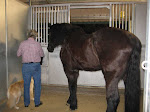
When I first got Doc he was a yearling who hung around humans and went with them when on a lead rope because he wanted to. He was not truly halter-broken and I was betting he wasn’t trained to stand tied either. I had a lot of experience with these problems by the time I acquired my big, black horse. And it was a darn good thing too!

The first time I ran afoul of the problem of an animal not being trained to wear a halter or collar was when I was about six years old and my grandfather gave me a puppy. If you want to know what it looked like look at the picture of Sassy. Incidentally, Sass is a descendent of the dogs my grandfather bred.

My grandmother named him Tripper because he would run between her legs and cause her to trip. Now, at sixty myself, I have a LOT more sympathy and understanding for the problem.

Putting a collar on Tripper was easy enough. He pitched a fit about wearing it, but eventually settled down and carried it. The real problem began when I tried to put a leash on him. He pitched a fit and alternately either was at the end trying to run away or laying down being dragged. I think my mother was the one who eventually taught him to lead, sort of. Tripper was never an ideal dog, but he sure taught me a lot of important things about animals.

My education with teaching animals to lead continued when we were at the farm of one of my mother’s cousins and there was a new foal. It was by a stallion named Yellow Jacket, something I didn’t appreciate until many years later, just as I didn’t recognize the significance of Joe Hancock as the sire of the old stallion another relative kept. For those of you not familiar with Quarter Horses these are some early stallions that contributed to the breed in a major fashion.

I was out in the pen with the mare and foal. Being a kid I found a bit of rope and managed to get it around the foal’s neck. The foal got away from me and wouldn’t let me near it again. Finally, afraid the foal would hurt itself with that noose around its neck; I went into the house and confessed what I’d done. The cousin who owned the mare went out and removed the loop. Then he told me, “It’s best not to mess with other people’s animals if you don’t know what you are doing.”
Sometimes I wish I’d taken that bit of advice to heart, but I didn’t.
I continued messing with other people’s horses every chance I got.

It may help you to understand when I tell you I was the kind of kid who, after watching her first episode of Superman, got a towel, tied it around my neck, climbed on the garage roof and jumped off. For most of my life that is how I’ve done things. Watch someone do it, then go out and try to do it myself.

Really now that I think about it this isn’t too far off the mantra of how to make a surgeon. Show one. Do one. Teach one. I will say though you end up with a lot more injuries when this is the way you learn to train horses and dogs.

As for Doc it was a good thing I had learned my lessons well by the time he came into my life because, as big as he was, I needed every thing I’d ever learned to turn him into a well-mannered horse.

Lazy Trainers Tip

To learn to train an animal find a professional you are comfortable with and learn how they do it. Then try it yourself. After that—teach someone else how to do it.